Showing posts with label memoir. Show all posts

Sunday, July 18, 2010

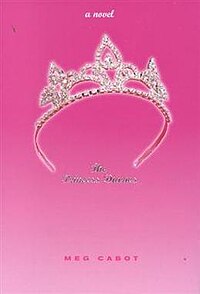
The Princess Diaries: Book to Film #2


Author: Meg Cabot
Illustrator: N/A
Year Published: 2000
Publisher: Harper Collins
Awards: ALA Best Book for Young Adults (2001)

What did you like/dislike about the book?
Meg Cabot's book, The Princess Diaries, is a story about an awkward high school freshman who finds out she is heir to the throne of Genovia.  It is written in the form of Mia's diary, with frequent entries showing her thoughts.  There are 10 volumes of The Princess Diaries, which cover 14 published novels.

This story is definitely not for young readers.  It discusses issues such as losing one's virginity, French kissing, periods, underage drinking, and breasts.  Many middle and early high school readers will be able to identify with Mia's self-conscious nature.  However, as an adult, I found her frequent whining a bit unpleasant. 

I liked the first-person point-of-view given throughout the book and felt Mia's experiences were comparable with real teens in modern times.  However, the book's focus was more on Mia keeping her secret than on her decision to become a Genovian princess.  Perhaps in the latter books, more attention is paid to her life in Genovia.


Movie TitleThe Princess Diaries (series)
Director: Garry Marshall
Year Produced: 2001
Starring: Anne Hathaway, Julie Andrews
Awards: N/A

What did you like/dislike about the movie?
The movie is more light-hearted and family-friendly than the books.  Especially entertaining are the scenes in which Mia gets her makeover and which chronicle her various misadventures at official palace events.

This movie is rated G and is appropriate for viewers of all ages and can frequently be found on the Disney Channel.  The other title in the series is Princess Diaries 2: Royal Engagement.

How do the book and movie versions of this title compare?
The main plot lines of both the book and movie are similar.  Mia is faced with her true identity, which comes as a shock, and she must balance being a teenager with being a princess.  However, some glaring differences occur.  In the movie, Mia lives in San Francisco, Mia's grandmother is a kindhearted queen (not a princess), and Mia's father is recently deceased and inactive in her life.  In the book, she lives in New York, her grandmother is reviled for her haughty nature, and Mia's father is an active presence in her life, albeit with testicular cancer.

What is surprising to me is that such a family-friendly movie would come out of a teen book.  I can imagine there have been various instances of young girls reading about Mia's misadventures, only to realize the mature subject matter.

Overall, the book was an okay precursor to the movie.  While the basic plots aligned, the subject matter and appropriate audience did not.  

Friday, July 16, 2010

A Yoshiko Uchida Tale


Author: Yoshiko Uchida
Illustrator: Charles Robinson
Year Published: 1978
Publisher: Atheneum
Awards: N/A

What did you like/dislike about the book?
Yoshiko Uchida's book, Journey Home, is a tale of a young Japanese girl's experiences during World War II.  She and her family are forced into the camps, where they have few possessions.  Her only brother has joined the Army and they are constantly worried about his safety.  Finally, little Yuki's family is allowed to leave the camps and return to Berkeley.  However, not everyone is happy to see Japanese families reintegrating into the community.  Yuki's family opens a grocery store, but their lives are not without hardships in California.

My favorite detail of the book is Yuki's perspective.  In today's schools, lessons about the Japanese interment camps are told from the American point of view.  Using Yuki's thoughts and feelings brings a fresh angle to the story.  For example, on page 16, "...she'd left Yuki feeling somehow ashamed of being Japanese.  And Yuki hated that."  American students would likely be surprised to learn of Yuki's feelings.

I also enjoyed the story of Yuki's brother, Ken.  A soldier's perspective on war can be much different than civilians'.  Ken seemed to be the most realistic character in the book.

At times, I felt this story was a little too syrupy.  Things just seemed to work out or other topics were glossed over.  For example, when dealing with their neighbors' fallen son.  Nothing was ever mentioned about the Japanese atrocities against Americans.  However, this can be attributed to the story being told from the girl's perspective.

This book is appropriate for older readers, particularly middle school.  The subject matter is inappropriate for younger readers and they will not have the background knowledge to comprehend.  Students will be able to identify with Yuki's feelings of being left out.  It can be used to teach about Japanese-American relations in the mid-20th century, as well as to study families, memoirs, or Japanese culture.  Uchida uses her own life experiences to tell young Yuki's story.

What in your life would have influenced this reaction/response?
I did not know much about the life of Japanese-Americans during the mid-20th century before reading this book.  All I had learned was from a textbook's perspective.  It is eye-opening to hear the story from a Japanese-American child's point-of-view.  Much like with any conflict, there are two sides affected by the issues.  This book caused me to think about other situations in which children on the "other side" are affected, such as the Iraq war.

How does this book compare to similar books/author’s other books?
Uchida's other titles involve realistic portrayals of a Japanese-American.  Many of her stories are reflections of events in her life.  Laurence Yep is another author who writes upon this subject matter. 

What did I learn about children’s literature from this book?
Perspective is a powerful tool, especially regarding juvenile historical fiction.  As a teacher, it is important to provide a well-rounded version of events for readers.  This text would be able to showcase the plight of others.

Other titles by this author include:

Saturday, July 10, 2010

The Hello, Goodbye Window (Caldecott #1)


Author: Norton Juster
Illustrator: Chris Raschka
Year Published: 2005
Publisher: Michael di Capua Books/Hyperion
Awards: Caldecott Medal (2006)

What did you like/dislike about the book?
Norton Juster's book, The Hello, Goodbye Window, is a whimsical memoir of a girl's day at her grandparents' house.  It is told using child-friendly language and from a child's point of view.  Many events center around the front window, out of which the characters can witness many things.

My favorite detail of the book is the voice.  I can hear a child telling all about their day and having someone transcribe it into this book.  Children will immediately identify with the main character, as many have special relationships with family or friends.  I also enjoy the fanciful illustrations.  They look childlike and in watercolor.

There is nothing about this book I did not like.

This book is appropriate in elementary classrooms.  It can be used as an example of memoir writing in the older grades.  However, the simplistic language may be too easy for older readers.

What in your life would have influenced this reaction/response?
I have a very positive reaction to this book because I have a strong relationship with my own grandparents.  In younger years, we would engage in many of the same activities as the book's characters.  

One notable detail is when the girl mentions how "nothing happens until I get up" from a nap.  This phrase is a perfect example of a child's self-centered world.

How does this book compare to similar books/author’s other books?
If memory serves me correctly, The Phantom Tollbooth is centered around a material object.  Characters in both books are able to be transported using the object.

Similar children's memoirs revolve around themes of family, love, acceptance, and a special item.

What did I learn about children’s literature from this book?
This book reminds me that oral language is the way an early writer begins to tell their stories.  In past classrooms, I have focused upon allowing students to write simplistic sentences.  The Hello, Goodbye Window shows me that students have large stories to tell.

Other titles by this author include:
The Phantom Tollbooth