Sunday, July 18, 2010

The Adventures of the Dish and the Spoon: International Title #2


Author: Mini Grey
Illustrator: Mini Grey
Year Published: 2006
Country of Publication: United Kingdom
Publisher: Alfred A. Knopf
Awards: Kate Greenaway Medal, Nestle Children's Book Prize Bronze Award

What did you like/dislike about the book?
Mini Grey's book, The Adventures of the Dish and the Spoon, is a fractured fairy tale, loosely based upon the children's verse "Hey Diddle Diddle."  It is told from the perspective of the Spoon.  After Dish and Spoon lose all their money, they are forced to rob a bank by mobsters.  After their release from prison, they find the world is a new place.

My favorite detail of the book is the charming plot.  Grey does an excellent job of taking familiar characters and creating a new world around them.  I also enjoy the scrapbook-style illustrations.  There are cheeky details in each picture that can definitely induce chuckles.

There was nothing about this book I did not like.

This book is appropriate for all ages of readers.  It can be used to discuss fractured fairy tales, personification, and character development.

What in your life would have influenced this reaction/response?
My students and I have always enjoyed fractured fairy tales because they put a fresh spin on familiar tales.  The characters of Dish and Spoon are well-developed enough that one feels sorry for them when they are imprisoned.  Strong characters are very important to me in a story.

How does this book compare to similar books/author’s other books?
Grey's other titles include additional fractured fairy tales.  Her books tend to personify inanimate objects and/or animals.  In each book, a similar bold illustration style is used.  Aside from a few different spellings, such as colour, there was no difference in this book and American-published books.

What did I learn about children’s literature from this book?
Fractured fairy tales can be just as enjoyable as the original version of the stories.  Students can learn the finer points of writing through children's books, especially those in which they are entertained.

Other titles by this author include:

You, Me, and the Big Blue Sea: International Title #1


Author: Marie-Louise Fitzpatrick
Illustrator: Marie-Louise Fitzpatrick
Year Published: 2002
Country of Publication: Ireland
Publisher: Roaring Brook Press
Awards: Bisto Book of the Year [Ireland] (2003)

What did you like/dislike about the book?
Marie-Louise Fitzpatrick's book, You, Me, and the Big Blue Sea, is a mother's retelling of a sea voyage to her young son.  She recalls the events of their voyage, including the sea birds, eating with the captain, and debarkation.  Each page ends with the same line "But you were only a baby, you wouldn't remember."

My favorite detail of the book is the detailed illustrations.  Fitzpatrick does an immaculate job of presenting very intricate and bright drawings.  The scene in the dining room is especially interesting because there is so much going on at once.  I also enjoy smaller, themed pictures on each text page.

I did not like the dismissive way the mother talked about the memories to her son.  Although the child probably didn't remember much from that trip, she didn't have to keep reminding him of his lack of memory.  Perhaps Ireland has different parent-child relationships than in the United States.

This book is appropriate for elementary classrooms.  It can be used to discuss memoirs, parent-child relationships, and sea voyages.

What in your life would have influenced this reaction/response?
Throughout this blog, I am finding that illustrations are important to the way I enjoy a book.  As an early childhood educator, I realize the need for pictures to convey lots of meaning to emergent readers.  I prefer my characters to have a little more relationship than the mother and son in this story.

How does this book compare to similar books/author’s other books?
The author's other titles have similar illustrations.  Fitzpatrick seems to favor simple forms with detailed settings.  Each of her books have a young child as a central character, usually interacting with older humans or animals.

What did I learn about children’s literature from this book?
Aside from possible parental differences between Ireland and America, there seems to be no difference in children's literature between the two countries.  Vivid illustrations can add a lot of weight to an otherwise simple story.

Other titles by this author include:

The Man Who Walked Between the Towers (Caldecott #5)


Author: Mordicai Gerstein
Illustrator: Mordicai Gerstein
Year Published: 2003
Publisher: Roaring Brook Press
Awards: Caldecott Medal (2004)

What did you like/dislike about the book?
Mordicai Gerstein's book, The Man Who Walked Between the Towers, is a tale of a young French acrobat and his desire to tightrope walk between the World Trade Center towers.  He snuck into the building under disguise and, aided by his two friends, set up the stunt.  As daybreak came, he walked a quarter-mile in the air on the tightrope for an hour.

My favorite detail of the book is the suspenseful way in which it is told.  Having not heard of Philippe's story before, I was worried he would plummet to his death.  I can imagine my students having similar reactions.  I also enjoyed the illustrations, especially the pull-out pages.  They attempt to replicate the grandeur of the towers.

This book is appropriate for all ages of readers.  It can be used to teach about brave stunts, to celebrate the World Trade Center towers, or about reaching your goals.

What in your life would have influenced this reaction/response?
Having not heard this story before, I was worried about Philippe's well-being.  Originally, I thought this book was written before the September 11 attacks and was surprised to see it was after those events.  Gerstein has a simplistic ending to his story that does not distract from Philippe's antics.

How does this book compare to similar books/author’s other books?
Other media surrounding this stunt, including the film Man on Wire, tell similar versions of the story.  Gerstein's other titles have complementary illustration styles to this book.  Lots of flowy lines, pastel colors, and zoomed in views are common.

What did I learn about children’s literature from this book?
Children's literature can be used to memorialize past historical events without distracting from their past.  The use of pull-out pages can be a surprising addition to a story's plot, especially when trying to convey grandeur.

Other titles by this author include:

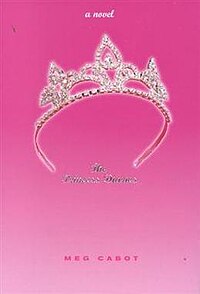
The Princess Diaries: Book to Film #2


Author: Meg Cabot
Illustrator: N/A
Year Published: 2000
Publisher: Harper Collins
Awards: ALA Best Book for Young Adults (2001)

What did you like/dislike about the book?
Meg Cabot's book, The Princess Diaries, is a story about an awkward high school freshman who finds out she is heir to the throne of Genovia.  It is written in the form of Mia's diary, with frequent entries showing her thoughts.  There are 10 volumes of The Princess Diaries, which cover 14 published novels.

This story is definitely not for young readers.  It discusses issues such as losing one's virginity, French kissing, periods, underage drinking, and breasts.  Many middle and early high school readers will be able to identify with Mia's self-conscious nature.  However, as an adult, I found her frequent whining a bit unpleasant. 

I liked the first-person point-of-view given throughout the book and felt Mia's experiences were comparable with real teens in modern times.  However, the book's focus was more on Mia keeping her secret than on her decision to become a Genovian princess.  Perhaps in the latter books, more attention is paid to her life in Genovia.


Movie Title: The Princess Diaries (series)
Director: Garry Marshall
Year Produced: 2001
Starring: Anne Hathaway, Julie Andrews
Awards: N/A

What did you like/dislike about the movie?
The movie is more light-hearted and family-friendly than the books.  Especially entertaining are the scenes in which Mia gets her makeover and which chronicle her various misadventures at official palace events.

This movie is rated G and is appropriate for viewers of all ages and can frequently be found on the Disney Channel.  The other title in the series is Princess Diaries 2: Royal Engagement.

How do the book and movie versions of this title compare?
The main plot lines of both the book and movie are similar.  Mia is faced with her true identity, which comes as a shock, and she must balance being a teenager with being a princess.  However, some glaring differences occur.  In the movie, Mia lives in San Francisco, Mia's grandmother is a kindhearted queen (not a princess), and Mia's father is recently deceased and inactive in her life.  In the book, she lives in New York, her grandmother is reviled for her haughty nature, and Mia's father is an active presence in her life, albeit with testicular cancer.

What is surprising to me is that such a family-friendly movie would come out of a teen book.  I can imagine there have been various instances of young girls reading about Mia's misadventures, only to realize the mature subject matter.

Overall, the book was an okay precursor to the movie.  While the basic plots aligned, the subject matter and appropriate audience did not.  

Friday, July 16, 2010

Caldecott vs. Newbery

What's the difference?

Both awards are bestowed upon children's books by the American Library Association.  The awardees must be American citizens or residents and have had their books published in the United States in the past year.  In addition to the medals, there is also a shortlist of honorees each year.

The Caldecott Medal is an annual award given to outstanding American children's illustrators.  It was established in 1938.  Most Caldecott award winners are picture books.  Notable past winners include The Polar Express (Van Allsburg), Song and Dance Man (Gammell), and Where the Wild Things Are (Sendak).

The Newbery Medal is an annual award give to outstanding American children's authors.  Established in 1922, it was the first children's book award in the world.  Most Newbery award winners are chapter books.  Notable past winners include Bridge to Terabithia (Paterson), Number the Stars (Lowry), and Walk Two Moons (Creech). 


Which medal is better?

While all are entitled to their own opinions, I believe the medals are incomparable.  Both of them require literary excellence for children, which can be a subjective decision.  In discussions of children's literature, the illustrations and text both play strong roles to tell a story.  I have often heard the argument that simple picture books are unworthy of these medals.  However, how many children have been turned on to reading by simply looking at the pictures?  That is the earliest form of literacy.

Shrek: Book to Film #1


Title: Shrek
Author: William Steig
Illustrator: William Steig
Year Published: 1990
Publisher: Farrar, Straus, Giroux
Awards: N/A

What did you like/dislike about the book?
William Steig's book, Shrek, is a tale of a disgusting ogre and his journey to a princess.  Shrek is happy to be foul.  His adventures take him to a witch, a peasant, a dragon, a donkey, a knight, and a castle.

The rhythmic tones each characters uses is delightful.  I did not expect Shrek to speak in poetic phrases.  Having seen the movies before reading this book, it was fun to note the similarities and differences.

While young readers will love Shrek's vile nature, the word "jackass" is used in relation to the donkey.  This is inappropriate for young readers.


Movie Title: Shrek (series)
Director: Andrew Adamson and Vicky Jenson
Year Produced: 2001
Starring: Mike Myers, Eddie Murphy, Cameron Diaz
Awards: Academy Award for Best Animated Feature (2002)

What did you like/dislike about the movie?
Shrek, surprisingly, comes off as a likable character in the film version of this story.  Although he tries to be surly and standoffish, his endearing qualities make him relatable.  As he journeys to rescue Princess Fiona (for the sake of his swamp and nothing more), he is joined by the loquacious Donkey.  This movie has a high number of jokes that will likely go over the heads of children, but amuse adults.

This movie is rated PG and is appropriate for most viewers.  There are some instances of bathroom humor, but they are handled appropriately.  Other titles in the series are: Shrek 2, Shrek the Third, and Shrek Forever After.

How do the book and movie versions of this title compare?
The main character in both versions is an ugly ogre.  He sets out on an adventure to get to the princess.  In the book, readers are given more of Shrek's backstory, including his parents' role.  He talks in poetic verse and does not interact with other characters beyond intimidating them.  In the movie, Shrek has more of a relationship with Donkey and has a different motive for saving the princess.

In both versions, Shrek is on an adventure across the countryside.  However, the book does not give much motivation behind Shrek finding the princess.  He seems so angry and off-putting, yet wants to find his love.  This was a disconnect to me.  In the movie, he wants his swamp to be free of annoying creatures, which was quite the motivation for an introverted ogre.

Overall, the book was a noble precursor to the movie version.  While the movie took many original creative licenses, the stories line up enough to be comparable.  I would recommend both versions to readers and viewers.

A Yoshiko Uchida Tale


Author: Yoshiko Uchida
Illustrator: Charles Robinson
Year Published: 1978
Publisher: Atheneum
Awards: N/A

What did you like/dislike about the book?
Yoshiko Uchida's book, Journey Home, is a tale of a young Japanese girl's experiences during World War II.  She and her family are forced into the camps, where they have few possessions.  Her only brother has joined the Army and they are constantly worried about his safety.  Finally, little Yuki's family is allowed to leave the camps and return to Berkeley.  However, not everyone is happy to see Japanese families reintegrating into the community.  Yuki's family opens a grocery store, but their lives are not without hardships in California.

My favorite detail of the book is Yuki's perspective.  In today's schools, lessons about the Japanese interment camps are told from the American point of view.  Using Yuki's thoughts and feelings brings a fresh angle to the story.  For example, on page 16, "...she'd left Yuki feeling somehow ashamed of being Japanese.  And Yuki hated that."  American students would likely be surprised to learn of Yuki's feelings.

I also enjoyed the story of Yuki's brother, Ken.  A soldier's perspective on war can be much different than civilians'.  Ken seemed to be the most realistic character in the book.

At times, I felt this story was a little too syrupy.  Things just seemed to work out or other topics were glossed over.  For example, when dealing with their neighbors' fallen son.  Nothing was ever mentioned about the Japanese atrocities against Americans.  However, this can be attributed to the story being told from the girl's perspective.

This book is appropriate for older readers, particularly middle school.  The subject matter is inappropriate for younger readers and they will not have the background knowledge to comprehend.  Students will be able to identify with Yuki's feelings of being left out.  It can be used to teach about Japanese-American relations in the mid-20th century, as well as to study families, memoirs, or Japanese culture.  Uchida uses her own life experiences to tell young Yuki's story.

What in your life would have influenced this reaction/response?
I did not know much about the life of Japanese-Americans during the mid-20th century before reading this book.  All I had learned was from a textbook's perspective.  It is eye-opening to hear the story from a Japanese-American child's point-of-view.  Much like with any conflict, there are two sides affected by the issues.  This book caused me to think about other situations in which children on the "other side" are affected, such as the Iraq war.

How does this book compare to similar books/author’s other books?
Uchida's other titles involve realistic portrayals of a Japanese-American.  Many of her stories are reflections of events in her life.  Laurence Yep is another author who writes upon this subject matter. 

What did I learn about children’s literature from this book?
Perspective is a powerful tool, especially regarding juvenile historical fiction.  As a teacher, it is important to provide a well-rounded version of events for readers.  This text would be able to showcase the plight of others.

Other titles by this author include: